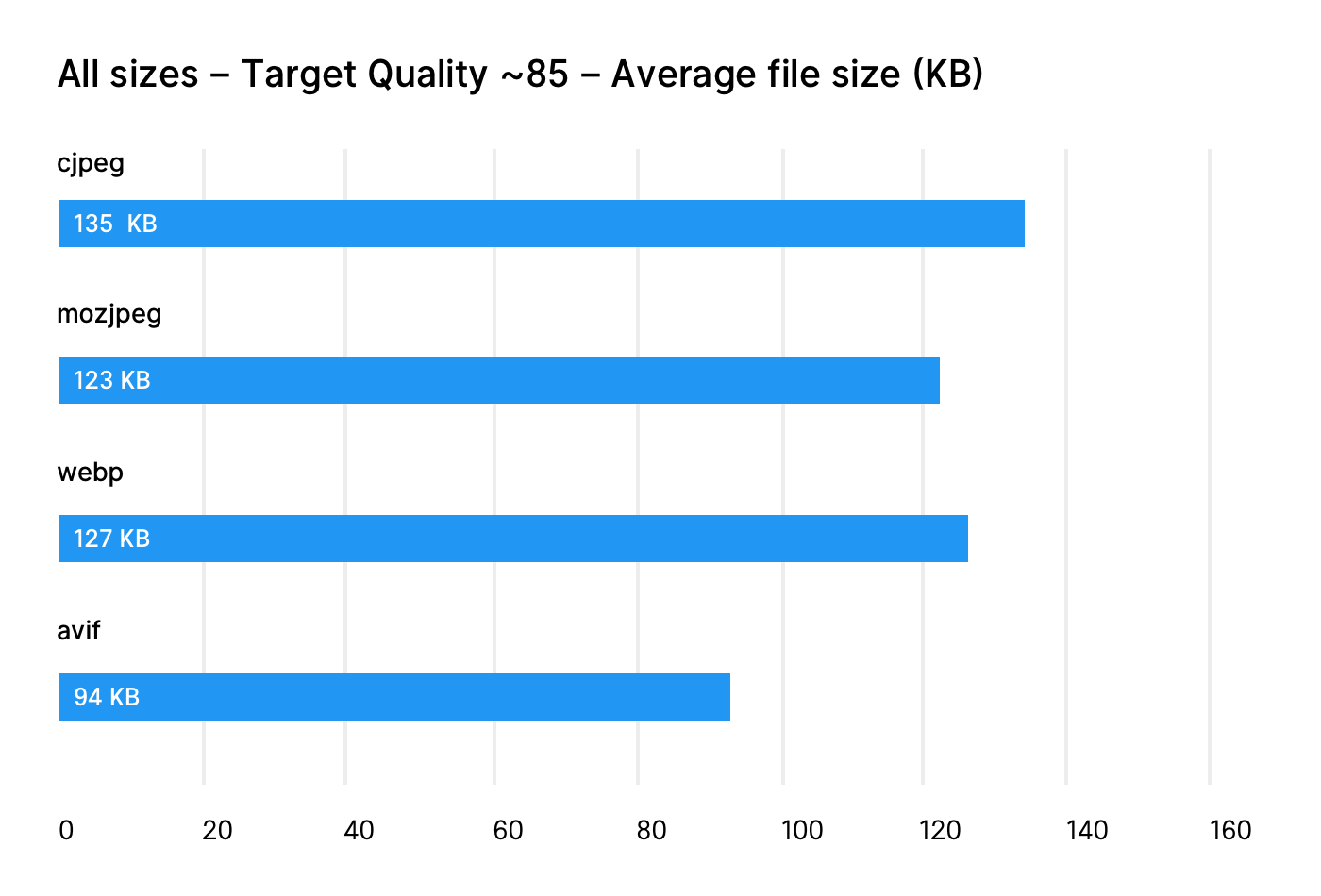
I tested this extensively for my photos (1200px) for the Piwigo gallery. Of course, you should have a high-resolution source file available for storage and then convert it into various other formats within the Photoshop workflow, for example.
Always adjust the quality of the compression optically, not numerically to the other formats. But I only focused on .jpg and webp and compared 21 photos exactly. Webp was significantly (ok not immense 😃) smaller.
The jpg data was on average around 0.7 - 1.2MB and webp was between 150-430kb (please don't overlook the fact that there are many more storage options for webP in professional tools). These were nature photographs with many details.
Thank you for your feedback on the exif data, I also believe that this has little meaning for the developers, so I will feed my gallery with .jpg data 🙂
@Zentalquabula
Your comparison lags because it's not exactly fair. You compare a text with a gradient and thus play out all the advantages of the higher bit depth and the avif format, since jpg or webP can only lose.
When you say that the avif format is more advanced, yes you are right. If you're saying that more like 8bit makes sense on the web, then you're wrong.
Not only does the corresponding hardware have to support this, which it rarely does, you also have hardly any advantages, which would justify the enormous effort involved in calculating it.
Just saving the format within Photoshop at this bit depth feels like forever. But even if you only use lower bit depths, the format would be unsuitable for Piwigo because the encoding takes far too long. You then have a small format, but it needs to be calculated which takes longer.
And that is exactly what will probably mean that avif will not be used more widely. Especially since it does not even officially support common software, let alone such formats can be opened in Windows by default.
Personally, I believe that jpg will stay with us for a very long time and that webP will come more and more, especially since it comes directly from Google (search engine preference of this format, Android which will introduce it by default, etc.)
In addition, the format is already supported by all common software packages and the storage is as fast as with jpg and Co. and already works very well on the web - except for the Exif output in Piwigo ;D